- 2026-08-18
- Events
- Featured Article
- By Pyxis Communication
AWS Summit CDMX 2026: Enterprise AI Just Left the Lab
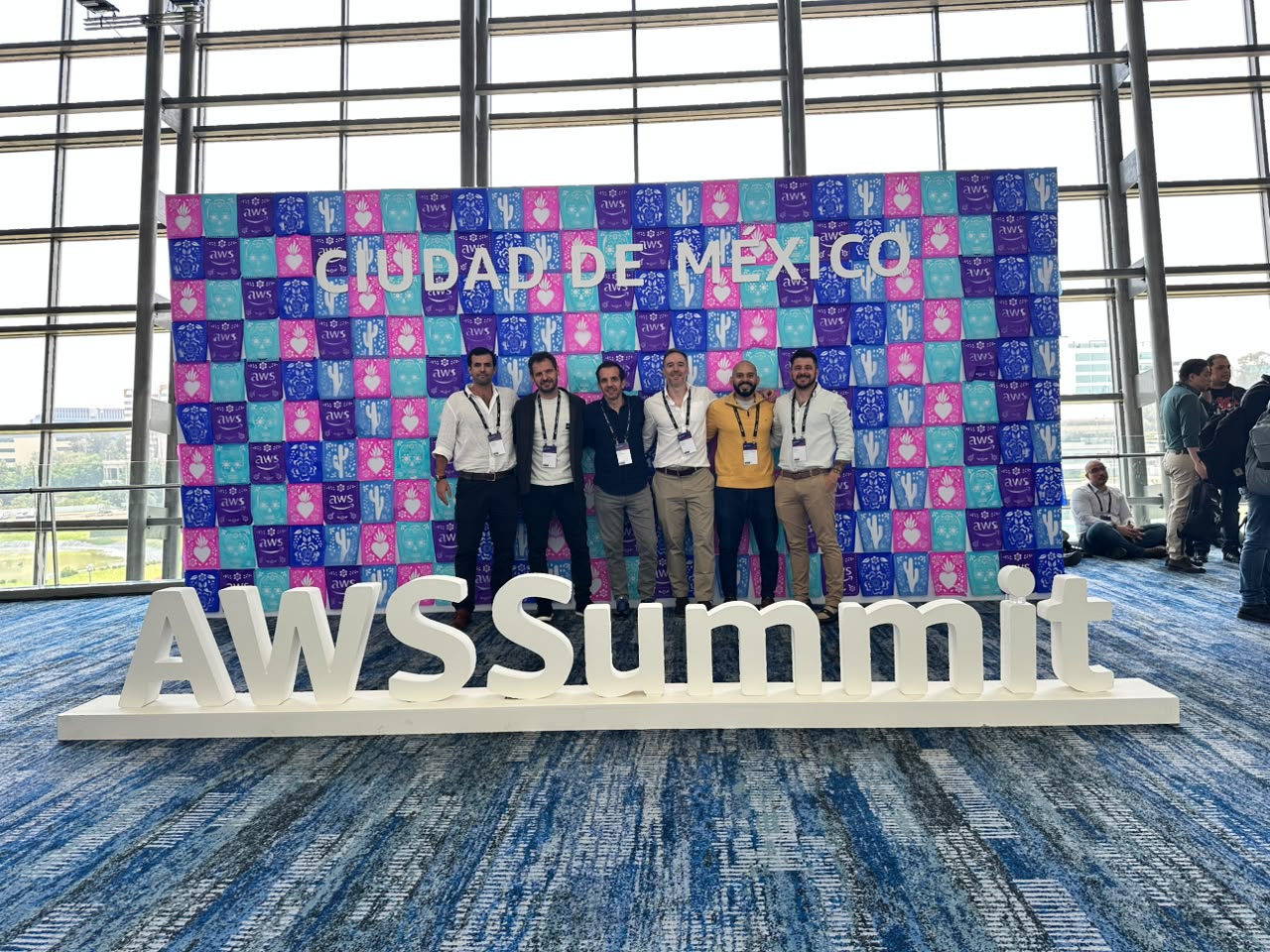
Last week we were at the AWS Summit in Mexico City. Between agents, data, and new services, one takeaway stood out: the conversation around enterprise AI is entering a new phase.
A year ago, most of the market was still figuring out how to build a good copilot. Today, AWS is talking about companies running thousands of agents a day, connected to real systems and taking actions, not just answering questions. Kavak, for example, shared that it runs between 100,000 and 200,000 AI agents daily (with peaks of 20,000 to 30,000 active at once) to handle customer service across phone, WhatsApp, app, and e-commerce, improving conversion by up to 2.4x.
That changes the problem quite a bit. Here are the three highlights we brought back from the event, and why they matter to us:
-
The PoC is no longer the hard part
One of the most visible shifts was the move from assistants that answer questions to agents that use tools, pull company data, and execute actions during a task. Kavak is the most extreme example we saw.
The question is no longer whether an agent can answer correctly. It’s what happens when it has access to CRM, payments, inventory, or internal systems and starts acting on our behalf. That’s where the interesting problems show up: permissions, identity, memory, cost, observability, and what to do when the agent gets it wrong.
Amazon Bedrock AgentCore harness is AWS’s answer to that infrastructure gap: it lets you define an agent’s model, instructions, and tools without building the entire orchestration layer from scratch, while still allowing customization when the use case calls for it.
-
The model is becoming the least interesting part
AWS Transform and AWS DevOps Agent point to another trend: agents are moving directly into the software lifecycle. AWS DevOps Agent – Release Management checks whether a release is ready to ship, validates builds in controlled environments, and catches regressions before they reach production. AWS Transform – Continuous Modernization analyzes technical debt, prioritizes modernization opportunities, and helps keep codebases up to date; according to AWS, it has already eliminated more than 1.6 million hours of manual work across its customer base.
These tools don’t replace architecture or product decisions, which still sit with the teams. But they are starting to take over a meaningful chunk of the work around those decisions. For us, that’s likely one of the biggest shifts of the next few years: less time maintaining software, more time deciding which software is worth building.
-
More autonomy also means more surface area for risk
When an agent only answers questions, a mistake produces a bad answer. When it can execute actions, a mistake can produce an incident. So it’s no surprise AWS is pushing security much closer to development, with AWS Continuum: a process spanning discovery, prioritization, validation, and remediation of risks, including code vulnerability analysis and threat modeling. One notable feature is the ability to validate findings in isolated environments, to confirm whether a vulnerability is actually exploitable before prioritizing it.
And here’s an idea we think is key: securing agents isn’t just about protecting the model. It’s about controlling what an agent can do, under what identity, on what data, and what evidence it leaves behind.
The next stage of enterprise AI won’t be won with more demos. It will be won by implementing with technical rigor, data governance, and a security layer designed in from the start.
As an AWS Advanced Partner with a dedicated Cloud, Data, and Cybersecurity team, this is an agenda we care about. If you’d like to talk about how it applies to your operation, let’s talk.
Tags

With a 360° potential, our solutions matrix accompanies the lifecycle of any project, with skills and experience in Development, Design, Q&A, Devops, Operation & Deploy, and Architecture
Discover all post